Scrolling r/hwstartups. Half paying attention. Then a title stops me: "How can I develop my extremely simple idea without giving it away?" Joe, the OP, has an idea simple enough to prototype with PVC pipe and injection molding. He's not asking if it's good. He's asking about NDAs. Patents. How to stop fifty strangers from stealing it before he ships.
Top comment, 75 upvotes: "There's so much more to a business than just the idea." One line. Undercuts his whole post. I expected pushback somewhere in the replies. Found none. Every comment just piled on from a different angle, so I went digging into why that consensus holds this hard, and found two founders who turned "obvious" ideas into six figures a month doing exactly what Joe was skipping.
The instinct to protect what isn't worth protecting
Joe's plan was NDAs first, product second. Understandable instinct if you've never shipped anything: the idea feels like the asset, so you guard it like one.
The second highest comment, 17 upvotes, says the quiet part: "Ideas don't mean anything, realistically. If you can't execute, you'll always be at the mercy of someone stealing it." A third commenter puts a number on it: "if it's an extremely simple idea, at least sixty people had the same idea." Sixty is obviously a guess, but the direction isn't wrong. Simple ideas are, by definition, the ones many people already had.
I see this pitch weekly, in the BizDev inbox: someone guarding a genuinely simple concept like it's a launch code, with zero proof anyone but them wants it built. Publisher-side, mobile gaming, not hardware. Same instinct, same blind spot.
Patents don't do what you think they do
One reply in that thread links to a real patent, US8857775B1, a gooseneck action-camera mount. Then links to an Amazon listing selling an almost identical mount, openly, for less. The patent exists. It changed nothing. If GoPro-adjacent hardware with actual legal budget can't stop a knockoff from ranking on Amazon, an unfiled idea posted by a first-time founder has no realistic protection at all.
A provisional patent gets suggested further down (cheap, $135, buys a year), and it's decent tactical advice for hardware specifically.
But.
Even that thread's own top voted reply calls it what it is: a head start, not a moat. The real filter is what happens after you ship, not what you file before.
Go Tall: proving demand before writing a line of code
Michael is 20, an NYU finance student who got rejected from the jobs he wanted and decided to build something instead. He found his idea on acquire.com, a height-prediction app for sale for $20,000. He remembered googling height calculators at 13 and thought: that's a real problem, I've lived it.
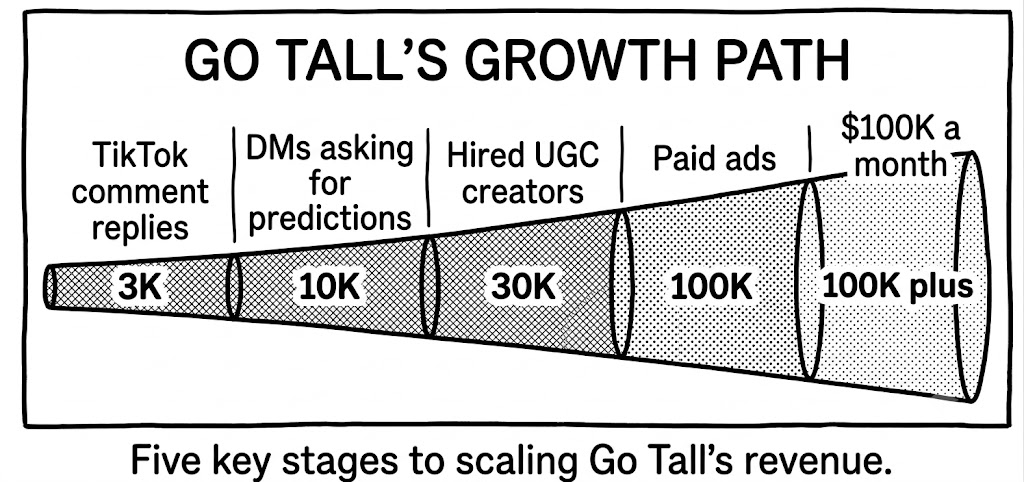
He didn't buy the listing. He rebuilt the concept and validated it before spending on anything. Two days after launch, first sale, with barely any views, which told him more than the sale itself did. Then he watched TikTok's height-related videos and noticed the same comment pattern over and over: "I'm six foot, I'm 15, my mom's this height, my dad's this height." People were begging to be told what they'd grow into. He started replying with predictions. Ten to twenty DMs a day followed, asking for the same thing. That's not a hunch, that's a queue of people telling you what to build before you build it.
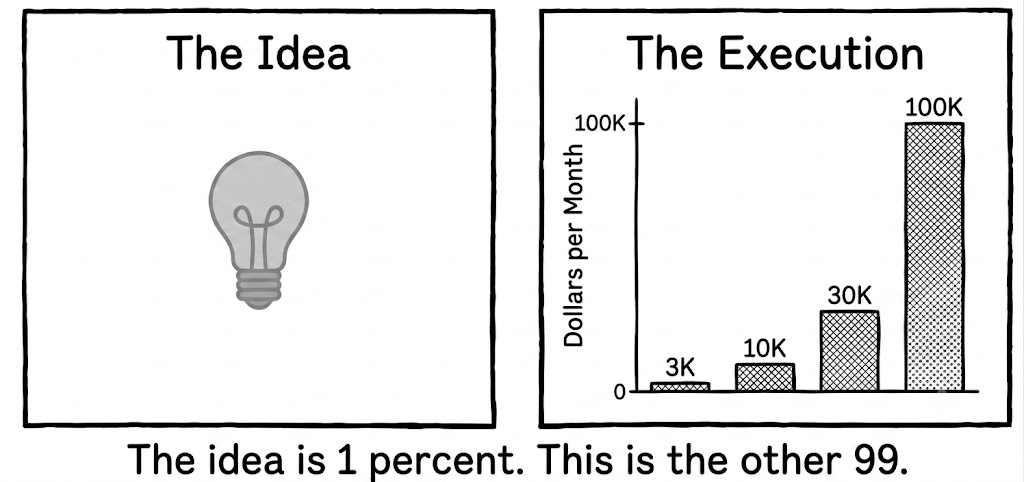
Revenue moved in a straight, named sequence: roughly 3K a month on his own TikTok content plus a few hired UGC creators, 10K after tightening the paywall (which now shows to 91% of users despite a long onboarding), 30K by month five as he found more content formats, then past 100K once he layered paid ads on top of formats that were already proven to convert. Every step scaled something that already worked. Nothing was a bet on an unproven idea.
Shipyard: cloning on purpose, then finding the 1 percent
David and his brother watched Base44 hit $3M ARR in six months and Lovable hit $1M ARR in a week, on its way to a $6B valuation, and drew a boring, correct conclusion: they didn't need a new idea. Owning even 1 percent of a market that size is life-changing. So they built Shipyard, a smaller AI app builder, on purpose, as a clone.
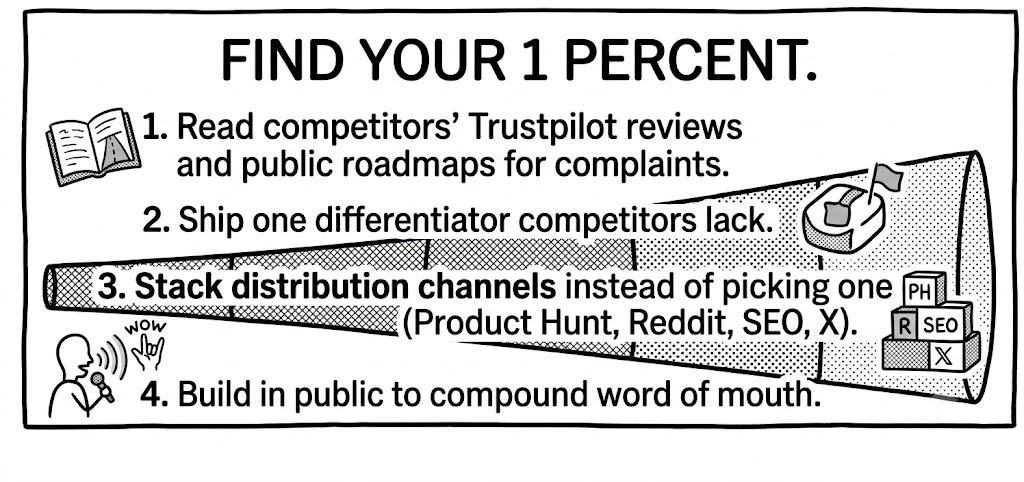
The differentiation didn't come from a flash of insight. It came from research they could have done from a laptop: reading competitors' Trustpilot reviews, public roadmaps, and Discord complaint threads, plus their own support chat, where someone asked "can you turn this website into a mobile app." Every other builder in the category was web-app only. Shipyard added mobile apps, Chrome extensions, and Discord and Telegram bots. That was the whole differentiator, and it was enough.
Distribution was sequential, not simultaneous, and that order matters as much as the channels themselves. Product Hunt in week one got their first $50 MRR. Reddit, regularly pulling 400 upvotes per post, pushed them from $50 to $1K. SEO on comparison keywords ("alternatives to [competitor]") ran in parallel. Then, around day 50 of building in public on X, growth went parabolic, adding roughly 20K MRR in one to two weeks from dogfooding the product in public. No paid channels, ever.
The actual moat is what the user sees
A separate Reddit thread lists five underserved, well-documented problems: delivery-app refund feedback, unreviewed AI-generated code shipping to production, landlord reputation tracking, cross-brand clothing sizing, and marketplace item authentication. All five ideas are, on paper, simple. The sharpest reply in that thread doesn't argue about which idea is best. It argues that two of them live or die entirely on visual execution: a landlord score has to read in five seconds like a credit score, not a wall of review text. A cross-brand size comparison needs a slider, not a table you have to translate in your head.
That's the actual moat. Not the idea, not a patent, not secrecy. Presentation, and how fast someone unfamiliar with your product understands what it does for them.
Why this calculus changes now
Here's the part that's new, not timeless. Replit's internal data shows a 5.8x increase in code shipped over six months, 2.9x per engineer even holding the team's composition constant. Agents are now doing incident triage, PR risk review, sales research, and closing support tickets 60% faster. That's one company's internal numbers, not an industry average, so take the multiplier with a grain of salt. But directionally, it matches what both Michael and David describe: build time keeps shrinking toward zero.
Which means "can I build this" stopped being the question worth asking. The bottleneck moved entirely to "can I prove someone wants this, and can I get to them faster than the other fifty people who had the same idea." AI made everyone's execution cheaper at the same time, so the founders who still win are the ones who validate first and move fastest after, not the ones with the most original idea.
Where I landed
If I had to compress this into something usable: stop asking whether your idea is original enough to protect, and start asking whether anyone has told you, unprompted, that they want it. A DM, a comment, a Trustpilot complaint about a competitor, all count. Then ship the cheapest version that tests that demand, and put your actual effort into the part people see first, the interface, the onboarding, the five-second read. That's the 99 percent nobody wants to hear about, because "I found an underserved niche" sounds better at a dinner party than "I read Trustpilot reviews for three weeks." I know which one actually pays rent :)