Kimi K3 vs Fable 5: The Race Just Shifted From Smartest Model to Cheapest Good-Enough Model
I was half-watching a Fireship recap on Kimi K3 when the number stopped me: 51% hallucination rate. Not from a hit piece, from artificial analysis, measured independently. That felt off, because the same video also had Kimi ranked #1 on the front-end code arena. So I went and watched the actual build-off, then an ARK Invest panel arguing about what any of this means for money. Three sources, three different angles on the same week. None of them told the story everyone was repeating.
The repeated story is "another DeepSeek moment, China caught up again." Moonshot's Kimi K3 dropped July 22, 2026, a Moonshot competitor's stock sold off 28% within hours, paid plans sold out, and Washington started floating entity listings for Chinese AI labs again (Polymarket had a US ban sitting at 29% odds at time of recording). Panic, basically. But panic is not what the data shows once you sit with it for more than a headline.
What K3 actually is
2.8 trillion parameters, mixture of experts with 896 total experts and exactly 16 active per token, 1 million token context, weights open on July 27. It's the largest open-weight model that has ever shipped, by a lot. The MoE setup is genuinely clever (16 experts doing the work while 880 sit idle, which if you've worked at a big publisher will sound extremely familiar) and makes scaling around 2.5x more efficient than Kimi's previous generation.
The benchmark asterisk
Here's where I slowed down. K3 is #1 on the front-end code arena at 1,679 Elo, ahead of both Fable 5 and GPT-5.6 Soul. Top 3 on the artificial analysis intelligence index too. Genuinely impressive numbers.
But some of those coding numbers were produced on Moonshot's own "Kimiko" harness while the competitors ran on different harnesses. That's not disqualifying, benchmarks are messy everywhere, but it is a reason to not take the #1 spot at face value. Moonshot itself admits K3 still trails Fable and GPT-5.6 Soul on Humanity's Last Exam by roughly 10 points. And that 51% hallucination rate is not nothing, especially for a model marketed on coding. It also burns more tokens per response than it needs to, which quietly eats into the "it's cheaper" pitch.
One verdict here: the benchmarks say K3 is close to the frontier, not on it. Close is still a big deal for an open model. It's just not the headline everyone ran with.
The test that actually matters
Benchmarks are one thing. Someone (a builder named Dubibubi) ran the test I actually cared about: same prompt, both models on max effort, one-shot, no revisions, three real builds. A premium e-commerce drop page, a 3D fighting game, a cinematic flight simulator.
- E-commerce page: Kimi $3.75, Fable 8.7x more expensive. Kimi finished in 51 minutes, Fable took over an hour. Fable's output won, animation was noticeably more polished.
- Fighting game: Kimi $3.68, Fable 10x more expensive, roughly half the time. This time it was close, the tester actually preferred Kimi's camera work.
- Flight simulator: gap narrowed to 6.7x. Fable's output "absolutely smashed it" on visuals. Kimi still shipped something genuinely playable, in less time, for less money.
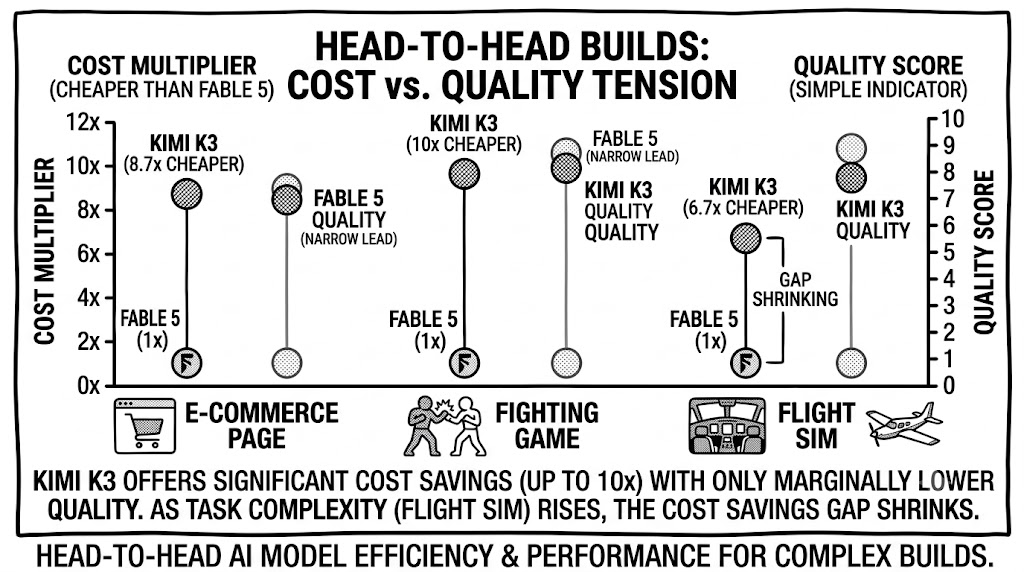
Pattern across all three: Kimi wins speed and cost by a wide margin, Fable wins output quality by a narrow one, and the cost gap shrinks as the task gets more creative and complex. That last part is the detail that didn't make it into anyone's tweet thread, and it's the one worth remembering if you're deciding which model to actually put in production.
China's open-weight sales pitch, briefly
There's a geopolitical subplot worth one paragraph, no more. At the World AI Conference, China's government became the loudest advocate for open, free AI, while in the US, the same old argument resurfaced that open weights are "decelerationist" (an actual quote, from OpenAI's Dean Ball). It's the Steve Ballmer "Linux is communism" bit, just with a different decade's villain. I'm not going to pretend I have a strong take on the policy fight. I'll just note that giving away a 2.8 trillion parameter model for free is either extremely generous or extremely strategic, and it's probably both.
Where the real money question is
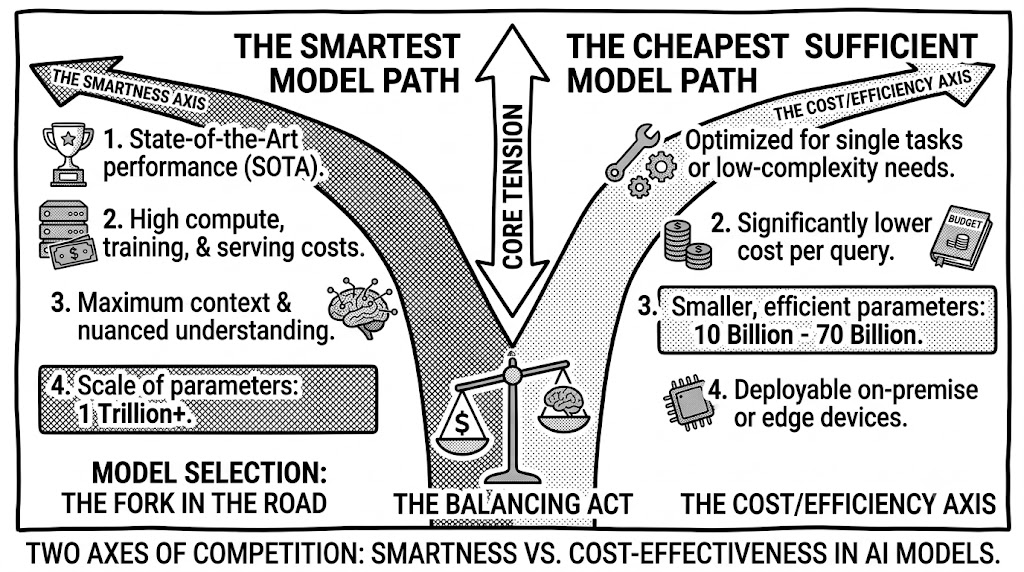
This is the part the ARK Invest panel got right, and it's the reason I'm writing this at all instead of just linking the Fireship video. Frank and Nick's framing: the frontier used to mean "smartest model," then it meant "smartest model at the lowest training cost," and now it means "smartest model at the lowest inference cost." Open models like K3 are optimized for the previous frontier (cheap training, because they're distilling), which is why they don't actually compete on the current one once you count tokens burned per task.
The number that stuck with me: on OpenRouter, over the last 30 days, open-source models took roughly 75% of token volume among the top 20 models, but closed models still took roughly 80% of the dollars. Everyone is using the free stuff, the money is still going to the expensive stuff. That gap between usage and spend is, in my opinion, the actual chart to watch here, more than any single Kimi benchmark.
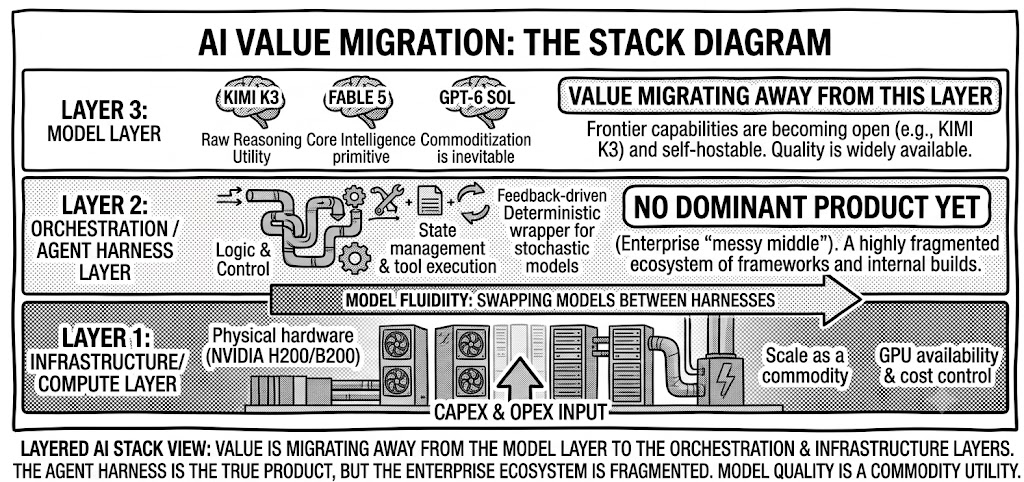
And here's the gap nobody on that panel could name a company for: an enterprise-ready product that routes each task to the cheapest model that can actually do it, that isn't just ChatGPT or Claude's own app. Frank said it outright, half-joking, half not: he's still waiting to see who builds the independent agent harness good enough to install instead of just defaulting to whichever chat app you already pay for. As of this week, it doesn't exist.
What I'd actually do with this
If I were picking a model for a real task tomorrow, the brief from this whole week boils down to one practical rule, borrowed from the ARK conversation: use the cheapest model that clears your task's ambiguity. Well-defined, narrow tasks tolerate a cheap model fine, K3 included. Genuinely ambiguous work still wants the smartest model you can afford, because a cheap model that has to guess will burn tokens compensating and end up costing you more anyway.
None of this makes Kimi K3 a Fable killer, and none of it makes Fable's price tag suddenly reasonable. It just means the interesting product to build right now isn't a smarter model. It's the thing that decides, per task, which model gets to answer. Someone is going to ship that. I don't know who yet, and neither, apparently, does ARK.