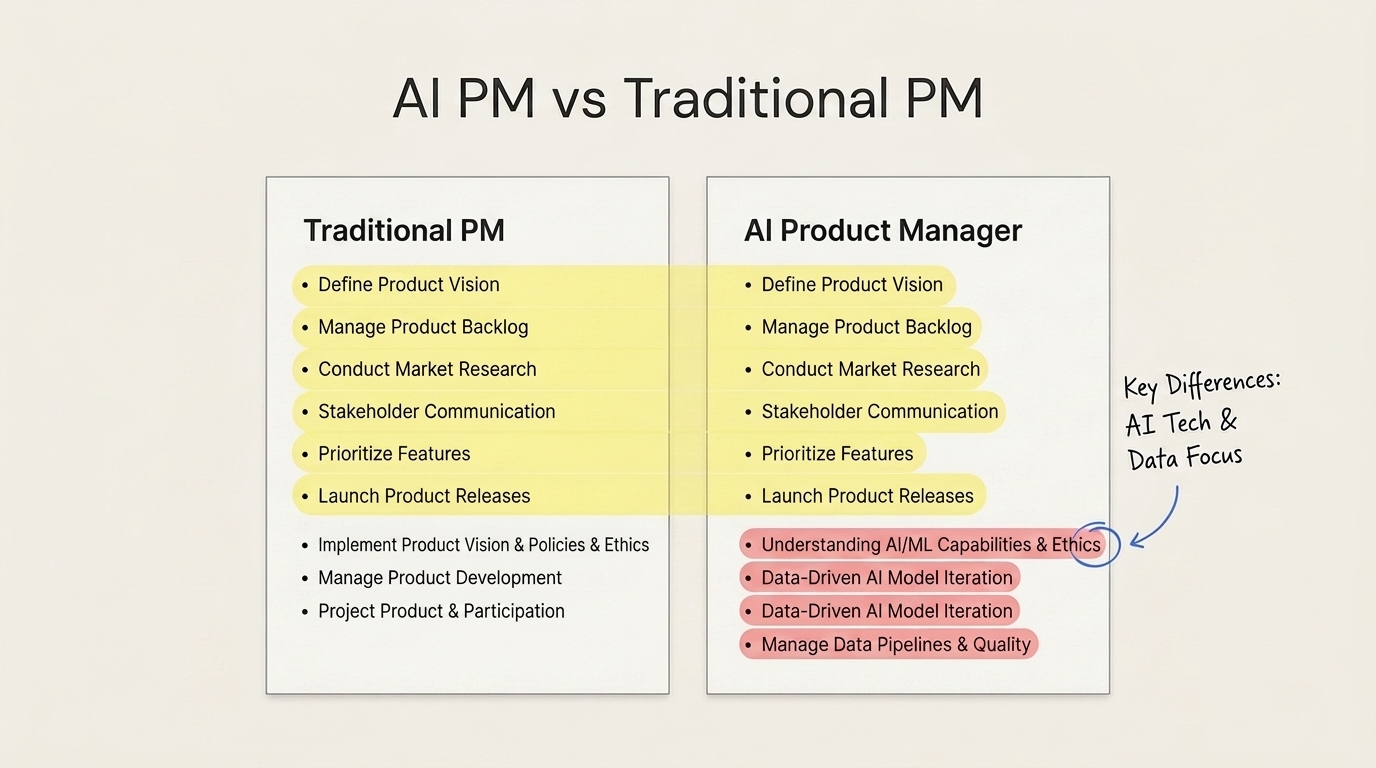
I read four AI product manager guides back to back on a Sunday, which I recommend to nobody. I came out with four different jobs.
Product School closes with an FAQ that asks my exact question, what separates a PM from an AI PM, and answers "There is no difference, per se." That sits on a page selling ten certifications built around the difference. Another guide disagrees hard enough to put a number on it: ML fundamentals get a "+400%" importance delta over traditional PM. A third opens by saying the fastest way to not become an AI PM is to spend six months studying machine learning math.
No difference, plus four hundred percent, and don't bother. I wanted one answer to one question, which is what my own job would look like if I took the title, and instead I got a genre.
The fourth source did something the others didn't. It counted.
Someone went and counted
JobRoadmaps scanned 100 live AI PM postings and ranked what employers wrote down. Product roadmap definition and prioritization sits at the top, named in 92% of them. ML/AI fundamentals comes fourth at 83%. Prompt engineering, the skill the entire course market is built on, appears in 54%.
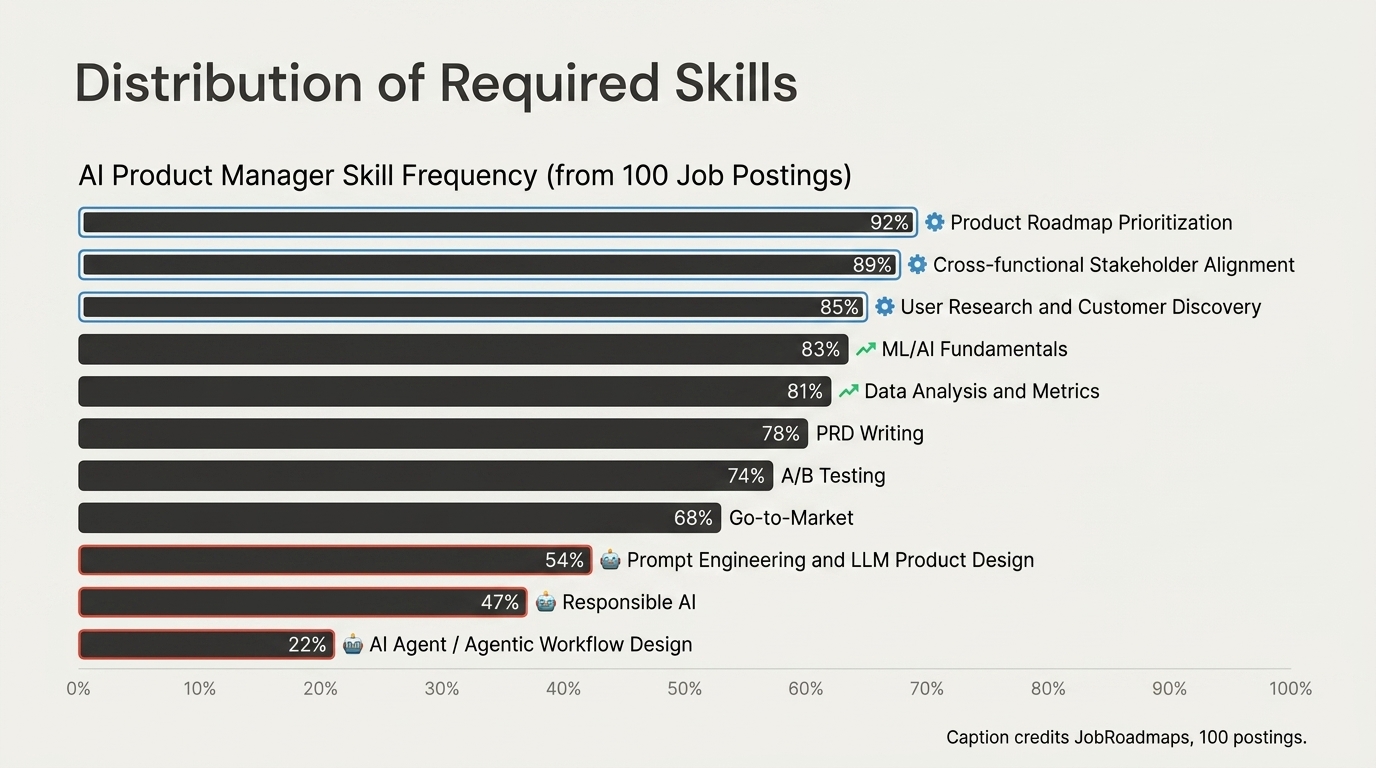
The top of that list is a product manager job description with nothing bolted on. Companies are hiring PMs and asking them to be literate about models, not hiring model people and asking them to be literate about product.
Their own caveat is the honest part and I will pass it along: these frequencies are what recruiters write, not what hiring managers enforce. (I have hired against my own job descriptions enough times to believe that one without argument.) Down in the niche tier, agentic workflow design shows up in 22% of postings and AI Act compliance in 18%. Those are the two I would bet move the most over the next year, though I would not tell you which direction.
So the skill list is roughly the same list, and that is not where the job changes. It changes because three artifacts I write every single week stop working when the system underneath them is probabilistic.
The skill list survived the transition. Three artifacts underneath it did not.
The acceptance criterion stops working
One sentence from that third guide has been rattling around my head since. A classic PRD says "when the user clicks X, show Y." An AI feature says "when the user asks X, the model usually returns something close to Y."
Usually. Close to. Those two phrases wreck the most load-bearing artifact a PM produces. You cannot QA against "usually", and you cannot put "close to Y" in a ticket and expect anyone to close it. The acceptance criterion is what the whole building agrees to before work starts.
But.
It doesn't vanish, it changes shape. What replaces it is an eval set: golden cases, known failure modes, a stated pass bar, all of it written by the PM because nobody else in the room is going to decide what "good enough" means. The first time I sat in a spec review for an AI-enabled feature, I asked the same question I always ask, how will we know it works, and watched the silence do something new. Everyone had an answer for a deterministic feature. Nobody had one for this.
What surprised me was who ends up owning the number. I assumed the pass bar was a technical question and that the people closest to the model would set it. It isn't and they don't. Choosing 90% over 95% is a product decision with a cost curve behind it, and the gap between those two numbers can be a quarter of engineering time, so it lands on whoever holds the roadmap. That is me. My first instinct was to ask for higher, the way you ask for more polish, until somebody walked me through what the last few points were going to cost and I understood I had been negotiating against my own backlog.
You stopped writing down a value and started writing down a distribution.
Every model call has a price tag
This one lands on the PM desk and surprises people coming from pure SaaS, though not people who have shipped free-to-play.
In F2P you already carry a per-action cost that scales with engagement rather than revenue, and you already know the specific horror of a feature winning every dashboard metric while the infra bill outgrows the ARPDAU it produced. You learn to price the action, not the feature. You learn that "users love it" is not an argument, it is one variable in a formula whose other terms are calls per session, retention, and how much of that usage sits in your free tier. An LLM feature is the same shape with a worse constant and a vendor who can reprice it without asking you. The reason it becomes a product decision and not a finance one is timing: finance sees it a quarter later, and by then the behaviour is trained, the retention curve has moved, and pulling the feature costs more than the margin it was burning.
Unrelated: one of these guides drops a line I have now used twice in performance reviews. "Certificates don't get hired. Artifacts do." Nothing to do with AI. Moving on.
Which is why the cost model belongs inside the spec, next to the eval set, before anyone builds anything.
The tokens are not the expensive part. The habit you trained is.
So when is this thing done?
It isn't. Models drift, and they need retraining, monitoring and fresh data just to hold the accuracy they launched with.
The cost of that shows up in planning rather than engineering. Every AI feature you ship keeps a permanent line in the roadmap and competes for capacity against new work forever. Two years in, a real share of your quarter is maintenance on things already declared done, and that is a conversation with leadership that goes badly the first three times you have it. My advice to myself, which I did not follow the first time: put that line in the roadmap on day one, while everyone is still excited, instead of discovering it during planning when it looks like you underestimated.
And one consequence nobody lists next to the others. In classic PM work the error state is the last ticket in the sprint, the one that gets cut when the date moves. Build on a model and wrong output is not an edge case, it is the steady state at whatever rate you signed off on. A feature that is right 92% of the time and gives the user no way to tell which visit they are on is not a good feature, it is a trust problem with good metrics.
Nothing you ship with a model inside it ever fully leaves your roadmap.
How much work is "AI-powered" doing?
Both of the taxonomies I read split the world in three, and both make room for a middle category: the PM who uses AI tools to work faster. One of them is blunt about it and says that middle box "isn't a career path. It's a skill, not a job."
That guide is right, and the distinction is the whole argument. Drafting a PRD with Claude is not a career move, it is a tool upgrade every PM in the building gets free within eighteen months, the way we all got spreadsheets. Owning a feature whose output is a distribution is a different job with a different definition of done. Blurring the two is what the certification market is selling, and "no difference, per se" is what that blur sounds like on a page that also has ten courses to move.
Everyone in the building gets the tools. Not everyone signs for the output.
What changed on my desk
Less than any of these guides would like. Same doc, same roadmap argument, same prioritisation meeting where somebody's pet feature refuses to die.
What changed is the signature. I hold go/no-go authority, and the line where I used to write some version of "works as specified" now carries a percentage and a list of the cases where it doesn't. So I ask for the failure examples before the demo, because the demo is always the golden case. Nobody has ever opened a go/no-go with the bad outputs on slide one. I keep waiting :)